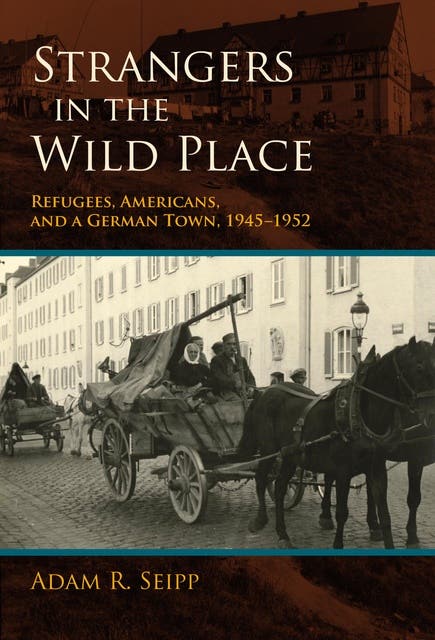
Strangers in the Wild Place: Refugees, Americans, and a German Town, 1945–1952
Sinopsis de Strangers in the Wild Place: Refugees, Americans, and a German Town, 1945–1952
A history of the post–World War II refugee camp located in Wildflecken, Germany.In 1936, the Nazi state created a massive military training site near Wildflecken, a tiny community in rural Bavaria. During the war, this base housed an industrial facility that drew forced laborers from all over conquered Europe. At war's end, the base became Europe's largest Displaced Persons camp, housing thousands of Polish refugees and German civilians fleeing Eastern Europe. As the Cold War intensified, the US Army occupied the base, removed the remaining refugees, and stayed until 1994. Strangers in the Wild Place tells the story of these tumultuous years through the eyes of these very different groups, who were forced to find ways to live together and form a functional society out of the ruins of Hitler's Reich."This well-researched and well-documented . . . book will contribute to the growing literature of the refugee crisis throughout postwar Europe and the variety of populations gathered on Allied occupied German territory, and thereby forcefully challenge the myth that the conspicuous and anxiety-provoking presence of "non-Germans" is a new "problem" for Germany. . . . It demonstrates clearly . . . that it was the presence of foreign east European DPs as well as American occupiers that served to push the integration of ethnic German refugees into the young Federal Republic and to reconstitute in the wake of a catastrophic war a new and highly functional Volksgemeinschaft." —Atina Grossmann, New York University"In clear, straightforward prose, Seipp does yeoman's work with his extensive use of both primary and secondary sources. . . . His treatment of the pentagonal interaction of the camp's residents, the town of Wildflecken, the US Army, the UNRRA and the Land of Bavaria contributes to a greater understanding of just how complex the reconstruction of a country's socio-political infrastructure must necessarily be in the aftermath of a major conflict." —German History
Más audiolibros de Historia
 De meeste mensen deugen: Een nieuwe geschiedenis van de mensAudiolibro · Rutger Bregman · ★ 4.7
 Sapiens: A Brief History of HumankindAudiolibro · Yuval Noah Harari · ★ 4.5
 Sapiens: Een kleine geschiedenis van de mensheidAudiolibro · Yuval Noah Harari · ★ 4.5
 México bizarroAudiolibro · Alejandro Rosas, Julio Patán · ★ 4.3
 Het water komtAudiolibro · Rutger Bregman · ★ 4.4
 Historias de la historia - T01E01Audiolibro · Javier Sanz · ★ 3.9
 21 lessen voor de 21ste eeuwAudiolibro · Yuval Noah Harari · ★ 4.5
 La memoria rende liberiAudiolibro · Liliana Segre · ★ 4.8